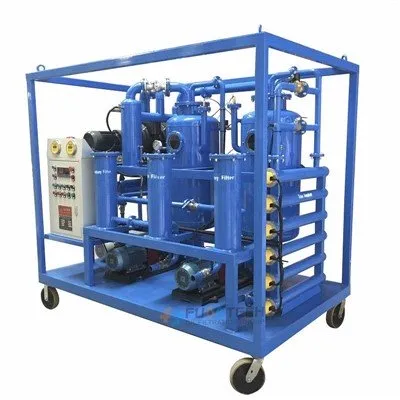

When dealing with liquid purification and gas removal, vacuum degasifiers stand out as vital equipment in numerous industries. As a prominent vacuum degasifier supplier, I often encounter a common question: "What is the maximum gas content that a vacuum degasifier can reduce a liquid to?" In this blog, I'll delve into this query, exploring the factors that influence the gas - reduction capabilities of vacuum degasifiers and providing insights from a supplier's perspective.
How Vacuum Degasifiers Work
Vacuum degasifiers operate on the principle of Henry's law, which states that the amount of a given gas that dissolves in a liquid is directly proportional to the partial pressure of that gas above the liquid. By creating a low - pressure environment (vacuum) within the degasifier, the solubility of gases in the liquid decreases, causing the gas to be released from the liquid phase and then removed.
The process typically involves the following steps: First, the liquid is introduced into the degasifier chamber. The chamber is then evacuated to lower the pressure. As the pressure drops, the dissolved gases start to form bubbles and rise to the surface of the liquid. These bubbles are then collected and removed from the system, leaving behind a liquid with a reduced gas content.
Factors Affecting the Maximum Gas Reduction
Type of Liquid
Different liquids have different gas - solubility characteristics. For example, water can dissolve a certain amount of oxygen, nitrogen, and carbon dioxide. Organic solvents, on the other hand, may have different affinities for various gases. The chemical composition of the liquid, its viscosity, and its temperature all play a role in determining how much gas it can hold and how easily the gas can be removed. A more viscous liquid may impede the movement of gas bubbles, making it more difficult to achieve a low gas content.
Type of Gas
The nature of the gas also matters. Some gases are more soluble in liquids than others. For instance, carbon dioxide is more soluble in water than nitrogen. The molecular size and polarity of the gas can influence its solubility and the ease of removal. Smaller and more non - polar gases may be more difficult to remove completely as they can interact more strongly with the liquid molecules.
Vacuum Level
The degree of vacuum created in the degasifier is a crucial factor. A higher vacuum level means a lower partial pressure of the gas above the liquid, which in turn leads to a greater driving force for the gas to escape from the liquid. However, achieving an extremely high vacuum level can be technically challenging and may require more advanced and expensive equipment.
Residence Time
The amount of time the liquid spends inside the degasifier also affects the gas reduction. Longer residence times allow more gas to be released from the liquid. In some industrial applications, the liquid may be recirculated through the degasifier multiple times to ensure maximum gas removal.
Typical Gas Reduction Ranges
In general, vacuum degasifiers can achieve significant gas reduction in liquids. For water - based systems, it is possible to reduce the dissolved oxygen content from several parts per million (ppm) to less than 1 ppm. In some cases, with highly efficient degasifiers and optimal operating conditions, the oxygen content can be reduced to even lower levels, approaching 0.1 ppm.
For other gases and different liquids, the achievable reduction levels vary. In transformer oil, for example, vacuum degasifiers can reduce the gas content to a very low level, which is crucial for maintaining the electrical insulation properties of the oil. Our ZY - 10 600 LPH Vacuum Transformer Oil Filtration Machine With PLC Controller is designed to effectively remove gases and moisture from transformer oil, ensuring its high - quality performance.


Case Studies
Let's take a look at some real - world examples to illustrate the gas - reduction capabilities of our vacuum degasifiers. A power generation company was experiencing issues with the insulation performance of their transformer oil due to high gas content. They installed our OLTC On Load Tap Changer Transformer Oil Purifier. Before using our equipment, the gas content in the oil was around 8%. After passing the oil through the degasifier, the gas content was reduced to less than 1%. This significant reduction improved the insulation properties of the oil and extended the lifespan of the transformers.
Another example comes from a chemical manufacturing plant. They were using a high - purity solvent in their production process, but the dissolved gas in the solvent was affecting the quality of their final product. Our ZYD - T - 50 3000 LPH Portable Enclosed Transformer Oil Degassing Dehydration and Filtration Machine was employed to treat the solvent. The initial gas content was 3 ppm, and after degassing, it was reduced to 0.2 ppm, meeting the strict quality requirements of their production process.
Realistic Expectations
While vacuum degasifiers can achieve remarkable gas reduction, it's important to note that it is nearly impossible to completely remove all the gas from a liquid. There will always be a small residual gas content due to factors such as the liquid's inherent gas - holding capacity and the limitations of the degassing process.
However, the technology is constantly evolving, and our research and development team is continuously working on improving the efficiency of our vacuum degasifiers. By optimizing the design, using advanced materials, and implementing better control systems, we aim to achieve even lower gas content in the treated liquids.
Conclusion and Call to Action
In conclusion, the maximum gas content that a vacuum degasifier can reduce a liquid to depends on multiple factors including the type of liquid, the type of gas, the vacuum level, and the residence time. With our state - of - the - art vacuum degasifiers, we are able to achieve significant gas reduction in various applications, such as transformer oil purification and high - purity solvent treatment.
If you are in need of a reliable vacuum degasifier for your specific application, we invite you to contact us for a detailed discussion. Our team of experts will provide you with the best solutions tailored to your requirements. Let's work together to improve the quality of your liquids through effective gas removal.
References
- Henry, William. “Experiments on the Quantity of Gases Absorbed by Water, at Different Temperatures, and under Different Pressures.” Philosophical Transactions of the Royal Society of London, vol. 93, 1803, pp.29 - 42.
- Bart, H. J. “Gas - Liquid Separation Technologies.” Handbook of Separation Process Technology, edited by Richard W. Rousseau, John Wiley & Sons, 1987, pp.601 - 632.
- Perry, Robert H., and Don W. Green. “Perry's Chemical Engineers' Handbook.” McGraw - Hill Education, 8th ed., 2008.