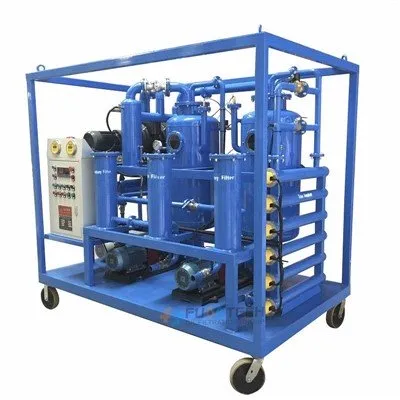

As a leading supplier of oil degassing systems, I've witnessed firsthand the critical role that gas detectors play in ensuring the efficiency and safety of these systems. In this blog post, I'll delve into the functions of gas detectors in an oil degassing system, highlighting their importance and how they contribute to the overall performance of the equipment.
Understanding the Oil Degassing System
Before we explore the role of gas detectors, it's essential to understand the basic principles of an oil degassing system. Oil degassing is a process used to remove dissolved gases, such as oxygen, nitrogen, and moisture, from transformer oil. These gases can accumulate in the oil over time, leading to a variety of issues, including reduced insulation performance, increased risk of electrical breakdown, and accelerated aging of the oil and equipment.
An oil degassing system typically consists of several components, including a vacuum chamber, a heating system, a filtration system, and a gas detection system. The vacuum chamber creates a low-pressure environment that allows the dissolved gases to escape from the oil. The heating system raises the temperature of the oil, which further enhances the degassing process. The filtration system removes any solid particles or contaminants from the oil, while the gas detection system monitors the concentration of gases in the oil and the system.
The Functions of Gas Detectors in an Oil Degassing System
Gas detectors play a crucial role in an oil degassing system by providing real-time information about the concentration of gases in the oil and the system. Here are some of the key functions of gas detectors in an oil degassing system:
1. Monitoring Gas Concentration
One of the primary functions of gas detectors in an oil degassing system is to monitor the concentration of gases in the oil. By continuously measuring the gas concentration, the detector can provide valuable information about the effectiveness of the degassing process. If the gas concentration remains high after the degassing process, it may indicate that the system is not functioning properly or that there is a problem with the oil.
For example, if the oxygen concentration in the oil is too high, it can lead to oxidation of the oil, which can cause the oil to break down and lose its insulating properties. By monitoring the oxygen concentration, the gas detector can alert the operator if the concentration exceeds the recommended level, allowing them to take corrective action, such as adjusting the degassing process or replacing the oil.
2. Detecting Gas Leaks
Another important function of gas detectors in an oil degassing system is to detect gas leaks. Gas leaks can occur in the system due to a variety of reasons, such as faulty seals, damaged pipes, or improper installation. If a gas leak is not detected and repaired promptly, it can pose a significant safety hazard, as the leaked gas can be flammable or toxic.
Gas detectors can detect gas leaks by monitoring the concentration of gases in the air around the system. If the gas concentration exceeds the normal level, it may indicate that there is a gas leak in the system. The detector can then alert the operator, allowing them to take immediate action to locate and repair the leak.
3. Ensuring System Safety
Gas detectors also play a crucial role in ensuring the safety of the oil degassing system. By monitoring the concentration of gases in the system, the detector can alert the operator if the concentration of flammable or toxic gases exceeds the safe level. This allows the operator to take appropriate safety measures, such as shutting down the system or evacuating the area, to prevent accidents and protect the personnel and equipment.
For example, if the concentration of hydrogen gas in the system exceeds the explosive limit, the gas detector can trigger an alarm, indicating that there is a potential explosion hazard. The operator can then take immediate action to reduce the hydrogen concentration, such as increasing the degassing process or venting the system.
4. Optimizing System Performance
Gas detectors can also help optimize the performance of the oil degassing system. By providing real-time information about the gas concentration in the oil and the system, the detector can help the operator adjust the degassing process to achieve the desired gas removal efficiency. This can result in improved oil quality, reduced maintenance costs, and increased equipment lifespan.


For example, if the gas detector indicates that the degassing process is not removing enough gas from the oil, the operator can adjust the vacuum level, the heating temperature, or the flow rate of the oil to improve the degassing efficiency. By continuously monitoring and adjusting the degassing process, the operator can ensure that the system is operating at its optimal performance.
Our Oil Degassing System Products
At our company, we offer a wide range of oil degassing system products that are designed to meet the specific needs of our customers. Our products are equipped with advanced gas detection systems that provide accurate and reliable gas concentration measurements. Here are some of our popular products:
- ZYD-T-O Fully Enclosed Transformer Oil Purifier With Mobile Double Axle Trailer: This product is a fully enclosed transformer oil purifier that is designed for mobile applications. It is equipped with a high-efficiency degassing system and a gas detection system that can monitor the concentration of gases in the oil and the system.
- BZ Independent Oil Regeneration System: This product is an independent oil regeneration system that is designed to remove impurities and contaminants from transformer oil. It is equipped with a gas detection system that can monitor the concentration of gases in the oil and the system, ensuring the quality of the regenerated oil.
- ZY-10 600 LPH High Efficiency Single-stage Vacuum Transformer Oil Purifier: This product is a high-efficiency single-stage vacuum transformer oil purifier that is designed for small to medium-sized transformers. It is equipped with a gas detection system that can monitor the concentration of gases in the oil and the system, ensuring the efficiency of the degassing process.
Conclusion
In conclusion, gas detectors play a crucial role in an oil degassing system by providing real-time information about the concentration of gases in the oil and the system. They help monitor gas concentration, detect gas leaks, ensure system safety, and optimize system performance. At our company, we offer a wide range of oil degassing system products that are equipped with advanced gas detection systems. If you are interested in our products or have any questions about oil degassing systems, please feel free to contact us for more information and to discuss your specific requirements. We look forward to working with you to provide the best solutions for your oil degassing needs.
References
- [1] "Transformer Oil Degassing: Principles and Applications." Electrical Insulation Magazine, IEEE, vol. 25, no. 3, 2009, pp. 4 - 11.
- [2] "Gas Detection in Industrial Processes." Process Safety Progress, vol. 30, no. 2, 2011, pp. 150 - 156.
- [3] "Advanced Techniques for Oil Degassing in Power Transformers." Journal of Power Systems and Energy, vol. 8, no. 2, 2012, pp. 87 - 94.