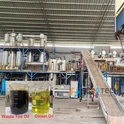


The Oil Moisture Tester is an automatic coulometric titrator based on Faraday's law and uses double platinum as the indicator electrode. The principle of the instrument to measure moisture is: when a water-containing sample enters an electrolyte containing constant iodine, it will consume the iodine in the electrolyte. After the change in iodine content is measured by the measuring electrode, iodine is precipitated on the anode of the electrolytic electrode to replenish the iodine consumed by the water. Since the number of grams of iodine molecules in the entire reaction process is equal to the number of grams of water molecules, the amount of moisture in the measured sample can be directly displayed on the screen after automatic processing by the instrument.

1. Reagent problem. Generally, the domestic reagent shelf life of Karl Fischer moisture meter is about one year. Special attention should be paid to the use of reagents that have expired or are close to the expiration date, which is prone to slow and difficult balance. In addition, when the electrolyte efficiency drops below 60%, it is also easy to have balance problems; generally, fresh reagents can be replaced. In addition, the reagents after opening must be properly stored and used as soon as possible.
2. Environmental humidity. The macrocoulometric method measures trace amounts of water. High ambient humidity can cause difficulty in balancing, especially when we use a Karl Fischer titrator in conjunction with a Karl Fischer heating furnace. Generally, silicone grease can be applied to each joint of the reaction cup to minimize the impact of humidity on the environment inside the cup, or the desiccant in the drying tube on the reaction cup can be replaced or replaced regularly if it fails (with the initial color change of the color-changing silica gel in the drying tube as an indicator). Secondly, the humidity of the environment can be controlled. A dedicated dehumidifier or an air conditioner with a dehumidification function can be used. If conditions permit, a dedicated glove box or a drying room can be provided.

3. There is water on the wall of the cup. Water on the wall of the cup, or water on the connection between the wall of the cup and the electrode, will cause difficulty in balancing; remove the electrode, drying tube and other accessories of the Karl Fischer titrator, pour out the electrolyte, clean the cup and electrode with anhydrous ethanol (the platinum wire is easy to break, so clean it carefully), and dry the reaction cup and its components at 50°C.

4. The carrier gas background is large. It only occurs when using carrier gas. Under the conditions of controlling the ambient humidity, the environment in the cup and using fresh reagents, the instrument can be balanced without carrier gas. After the carrier gas is connected, the instrument is unbalanced for a long time and the electrolysis value is stable at a high value. It is generally considered that the moisture content of the carrier gas is too high; generally, the desiccant used to purify the carrier gas can be replaced or a high-purity carrier gas (purity 99.99% and above N2) can be used.
5. Other situations. Electrode failure of the Karl Fischer titrator: such as electrode breakage, platinum wire breakage, wire damage, etc.
There are also errors in the parameter settings of the Karl Fischer titrator: you can contact our technical engineer to solve it.