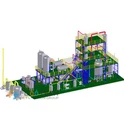


An electrostatic oil purifier is a device designed to remove contaminants from industrial oils (e.g., lubricating oils, transformer oils) using electrostatic forces. Its operation relies on the principles of electrostatics and the differential behavior of contaminants under an electric field. Here's a step-by-step breakdown:

1. Contaminated Oil Inflow:
The oil enters the purifier and flows through a pretreatment stage, where coarse particles and free water are mechanically filtered or settled to reduce the load on the electrostatic system.
2. Ionization and Charging:
The oil passes through an ionization chamber equipped with high-voltage electrodes (typically DC, 10-30 kV). These electrodes generate a non-uniform electric field. Contaminants such as fine metallic particles, carbon sludge, and polar water molecules acquire an electric charge through corona discharge or induction charging. Non-conductive particles may polarize, creating dipoles.
3. Migration and Separation:
Charged contaminants experience electrostatic forces (Coulomb force or dielectrophoretic force, depending on their conductivity). These forces drive the particles toward oppositely charged collector plates or grounded surfaces. Conductive particles (e.g., metal debris) are attracted directly to the electrodes, while polar liquids like water form larger droplets due to coalescence under the electric field, enhancing gravity-based separation.
4. Contaminant Collection:
The collector plates, often arranged in parallel or concentric configurations, trap the charged particles. Periodically, these plates are cleaned automatically or manually to remove accumulated sludge.
5. Purified Oil Outflow:
The cleaned oil exits the system with significantly reduced particulate content (<1 micron possible) and lower moisture levels. Some advanced systems integrate centrifugal mechanisms or adsorption filters to handle non-polar contaminants.

Key Advantages:
Electrostatic purification avoids frequent filter replacements, operates efficiently on submicron particles, and minimizes oil degradation by reducing thermal or chemical treatment. It is widely used in power transformers, hydraulic systems, and marine engines to extend oil life and enhance equipment reliability. The process is energy-efficient and environmentally friendly, as it generates minimal waste compared to traditional methods.