

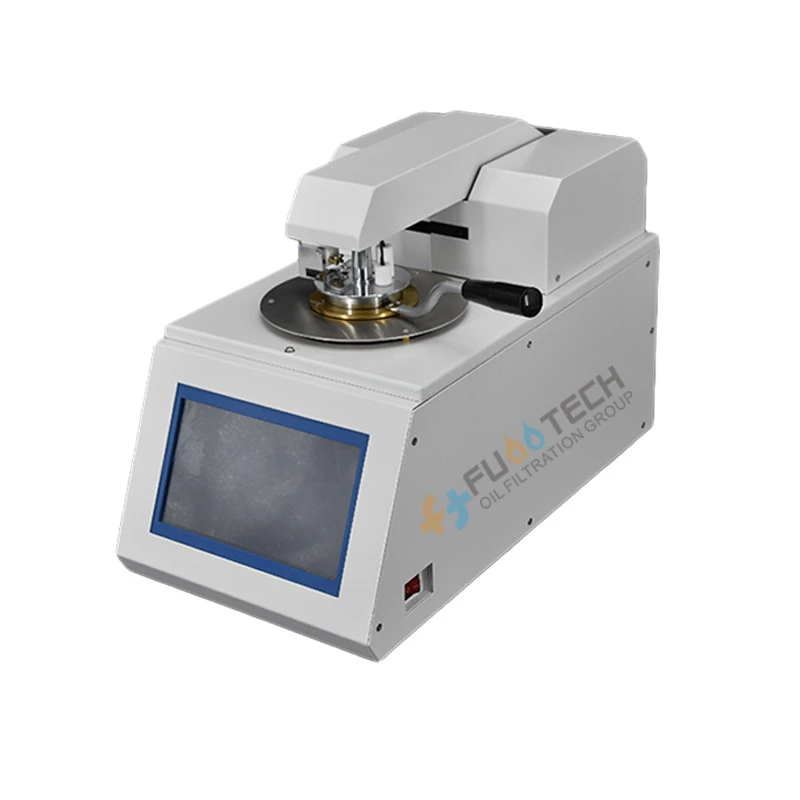
As the "gold standard" for assessing the safety performance of petroleum products, the ASTM D93 Pensky-Martens closed-cup flash point test method is undergoing a profound transformation, empowered by the deep integration of Industrial Internet of Things (IIoT) and artificial intelligence (AI) technologies. According to data from the newly released Global Laboratory Analytical Instruments White Paper in Q3 2025, the market penetration rate of intelligent closed-cup flash point testers equipped with connectivity and predictive maintenance capabilities has exceeded 35% in the Asia-Pacific region-marking the official entry of this classic test method into a new era of intelligence and networking.

I. Core Driving Forces: The Tripartite Balance of Regulations, Safety, and Efficiency
The closed-cup flash point test defined by ASTM D93 has long served as an indispensable safety checkpoint throughout the production, storage, transportation, and application of oil products. Its significance has further intensified in 2025, driven primarily by three key factors:
1. Global Regulatory Convergence: With the widespread implementation of the UN GHS (Globally Harmonized System of Classification and Labeling of Chemicals) across nations, requirements for the classification, labeling, and safety data sheets (SDS) of hazardous chemicals have become increasingly stringent. Accurate flash point data constitutes the core basis for classification, rendering compliance with international standards such as ASTM D93 a mandatory requirement.
2. Safety Challenges in the New Energy Supply Chain: In emerging sectors including biodiesel, aviation biofuels, and waste lubricant recycling, the compositional complexity of raw materials has posed unprecedented challenges to traditional test methods. A 2025 industry report reveals that market demand for enhanced automated testers capable of precisely measuring the flash point of oil products containing new components (e.g., oxygenates) has surged by 18% year-on-year.
3. Laboratory Efficiency Revolution: Propelled by the "lean laboratory" philosophy, traditional manual testing methods reliant on human observation and documentation are being rapidly phased out. Market demand for "unattended" batch testing, paperless data management, and real-time integration with Laboratory Information Management Systems (LIMS) has emerged as the primary driver for instrument upgrading and replacement.
II. 2025 Technology Frontiers: Three Trends Reshaping the Industry Landscape
Based on technical demonstrations at the recent International Fuels and Lubricants Conference held in Houston, the technological evolution of ASTM D93 closed-cup flash point testers in 2025 focuses on the following three directions:
- Trend 1: Preliminary Application of AIGC-Powered Visual Recognition Technology
Leading instrument manufacturers, such as Keou Standard Technology, have integrated AI-driven visual recognition systems into their flagship models launched this year. The system utilizes high-definition cameras to capture real-time microscopic changes in the liquid level within the test cup, leveraging deep learning algorithms to accurately identify "true flash" events. Its judgment accuracy is reported to be approximately 5% higher than that of traditional photoelectric sensors, significantly reducing misjudgments caused by impurity vapors or background light interference.
- Trend 2: Predictive Maintenance and Digital Twin
The latest intelligent testers are equipped with an expanded array of sensors to real-time monitor heating unit performance, mechanical stirrer torque, and gas path patency. Through cloud platforms, the instruments synchronize operational data to a "digital twin" model, enabling predictive fault diagnosis and issuing proactive alerts to users prior to required calibration or maintenance. This not only reduces unplanned downtime by up to 70% but also provides a comprehensive equipment status traceability chain for laboratory compliance audits.
- Trend 3: Seamless Ecosystem Integration
Mainstream equipment in 2025 transcends basic data output capabilities. Via standardized API interfaces, testers can achieve deep integration with Laboratory Information Management Systems (LIMS), Enterprise Resource Planning (ERP) systems, and even supply chain management platforms. For instance, once flash point test results for a batch of oil products are generated, they can automatically trigger qualification/release instructions in downstream systems or update product technical specifications in real time-realizing a closed loop from "data generation" to "decision execution."
Info from <Global Energy and Chemical Analysis Instrument Insights>